
Refer merchants using APIs
This documentation provides comprehensive guidance for integrating with PayU's Partner Integration API. This API enables businesses and individual partners to integrate PayU's payment solutions into their platforms, onboard merchants, and manage the complete merchant lifecycle.
Overview
PayU merchant onboarding APIs allows partners to:
- Onboard merchants to the PayU platform
- Manage merchant KYC processes
- Verify bank account details
- Handle electronic signatures for agreements
- Receive real-time status updates via webhooks
Authentication and Authorization
PayU Merchant Onboarding employs token-based authentication with OAuth 2.0 standards. Partners must obtain tokens through appropriate authentication endpoints before accessing the API resources.
Token Management Flow
The token-based authentication works as follows:
- Partners obtain an access token using their credentials
- This token is included in subsequent API requests
- Tokens expire after a set period and must be refreshed
Important: Access tokens should be securely stored and never exposed in client-side code.
Authentication
Obtain a bearer token before calling any onboarding API. Credentials are sent in the request body — no prior OAuth token is required for this call.
- GetToken API — Step 00
Merchant Onboarding Process
The Partner Onboarding flow follows a 16-step sequence. Each step depends on the previous one. Call GetToken (Step 00) first, then proceed through merchant creation, verification, KYC, and e-sign.
| Step | Name |
|---|---|
| 00 | Authentication (GetToken) |
| 01 | Create Merchant |
| 02 | Update: PAN + DOB |
| 03 | CKYC Verification |
| 04 | Update: Business Details |
| 05 | Update: Bank Details |
| 06 | Upload Bank Proof (conditional) |
| 07 | Update: Website Details |
| 08 | Add Signatory Details |
| 09 | DigiLocker Verification |
| 10 | Update: Addresses |
| 11 | Video KYC (VKYC) |
| 12 | Add/Update UBO |
| 13 | Business Members & KMP |
| 14 | Fetch Required KYC Documents |
| 15 | Upload KYC Documents |
| 16 | E-Sign Agreement |
Use GetMerchant (Utilities) between steps to check verification and onboarding status.
List of APIs
The APIs used in the onboarding flow are listed below. These map to the Partner APIs reference section:
| Description | API |
|---|---|
| Step 00 — Authentication | |
Obtains an OAuth bearer token for Partner Onboarding APIs. Call this first; use the returned access_token on all later steps. | GetToken API |
| Step 01 — Create Merchant | |
Creates a new merchant shell account on PayU. Returns mid, uuid, and product_account_uuid. | CreateMerchant API |
| Step 02 — Update Merchant Details | |
| Sets the merchant PAN and date of birth or incorporation. | UpdateMerchant PAN + DOB API |
| Step 03 — CKYC Verification | |
| Sends an OTP to the merchant mobile for CKYC verification (Individual / Sole Proprietorship). | Send CKYC OTP API |
| Verifies the OTP from Step 03A and returns CKYC identity data. | Verify CKYC OTP API |
| Fetches CKYC identity data using PAN without OTP (all other entity types). | Fetch CKYC Data API |
| Step 04 — Update: Business Details | |
| Adds business category, sub-category, expected volume, GST, business name, and CIN where required. | UpdateMerchant Business Details API |
| Step 05 — Update Bank Details | |
| Adds settlement bank account details. PayU attempts auto-verification after this step. | UpdateMerchant Bank Details API |
| Step 06 — Upload Bank Proof (Conditional) | |
| Uploads bank account proof when auto-verification from Step 05 failed. | Upload Bank Proof API |
| Step 07 — Update: Website Details | |
| Adds the merchant website and/or app store URLs. | UpdateMerchant Website Details API |
| Step 08 — Add Signatory Details | |
| Submits the authorised signatory for the merchant agreement. Prerequisite for DigiLocker. | Add Signatory Details API |
| Step 09 — DigiLocker Verification | |
| Creates a DigiLocker authentication URL for Aadhaar-based verification. | Generate DigiLocker Link API |
| Step 10 — Update: Addresses | |
| Adds registration and operating addresses for the merchant. | UpdateMerchant Addresses API |
| Step 11 — Video KYC (VKYC) | |
| Creates a Video KYC profile and returns a VCIP capture link. | Create VKYC Profile API |
| Step 12 — Add/Update UBO | |
| Submits Ultimate Beneficial Owner details (entity-dependent). | Add/Update UBO API |
| Step 13 — Business Members & KMP | |
| Submits directors, partners, or designated partners. | Submit Business Members API |
| Retrieves business members already submitted for the merchant. | List Business Members API |
| Step 14 — Fetch Required KYC Documents | |
| Returns document categories and accepted types required for the merchant. | Fetch Required KYC Documents API |
| Step 15 — Upload KYC Documents | |
| Uploads one KYC document per required category from Step 14. | Upload KYC Document API |
| Returns details for a previously uploaded KYC document, including a signed URL and status. | Show KYC Document API |
| Deletes a previously uploaded KYC document. | Delete KYC Document API |
| Step 16 — E-Sign Agreement | |
| Generates the merged merchant agreement document for electronic signing (final step). | Generate Agreement for E-Sign API |
| Utilities | |
| Retrieves the full merchant profile and verification statuses. Call between any steps to check progress. | GetMerchant API |
Create, Update, and Manage Merchants
APIs for merchant creation and profile updates across the onboarding sequence:
- GetToken API — Step 00
- CreateMerchant API — Step 01
- UpdateMerchant PAN + DOB API — Step 02
- UpdateMerchant Business Details API — Step 04
- UpdateMerchant Website Details API — Step 07
- Add Signatory Details API — Step 08
- UpdateMerchant Addresses API — Step 10
- Add/Update UBO API — Step 12
- Submit Business Members API — Step 13
- List Business Members API — Step 13
- GetMerchant API — Utilities
Bank Account Verification
Bank account verification is handled during Steps 05 and 06. PayU attempts auto-verification after bank details are submitted; upload bank proof only if auto-verification fails.
- UpdateMerchant Bank Details API — Step 05
- Upload Bank Proof API — Step 06 (conditional)
- GetMerchant API — Check
bank_verification_statusbefore deciding whether Step 06 is needed
KYC Document Management
The KYC process requires merchants to provide various identification and business documents. These APIs facilitate document upload and verification.
Document Requirements
Different merchant types require different documentation. The exact requirements should be determined by referencing the official PayU documentation.
Document Upload APIs
KYC and identity verification APIs across Steps 03, 09, 11, 14, and 15:
- Send CKYC OTP API — Step 03A
- Verify CKYC OTP API — Step 03B
- Fetch CKYC Data API — Step 03C
- Generate DigiLocker Link API — Step 09
- Create VKYC Profile API — Step 11
- Fetch Required KYC Documents API — Step 14
- Upload KYC Document API — Step 15
- Show KYC Document API — Step 15
- Delete KYC Document API — Step 15
Document Types and Guidelines
PayU accepts various document types for KYC verification, including:
- Identity proofs (PAN Card, Aadhaar, etc.)
- Address proofs
- Business registration documents
- Bank account proofs
For an exhaustive list of documents required for an entity, please refer to KYC Checklist.
For an the business category & subcategory details, please refer to Partner Category List.
E-Sign Flow
The electronic signature process is required to complete merchant agreements. PayU provides specific APIs to manage this workflow.
For e-signature specifications, please refer to:
E-sign APIs
- Generate Agreement for E-Sign API — Step 16
Webhooks for Real-Time Updates
Webhooks allow partners to receive notifications about changes in merchant status without polling the API.
For webhook integration details, please refer to:
Security Considerations for Webhooks
Webhook requests should be authenticated to ensure they come from PayU. Implementation details can be found in the webhook documentation.
Error Handling and Troubleshooting
Common KYC Errors and Solutions
KYC document verification can encounter various issues. For detailed information on common errors and their solutions, please refer to:
KYC errors
Common issues include:
- Document quality problems
- Information mismatches
- Missing required fields
- Format incompatibility
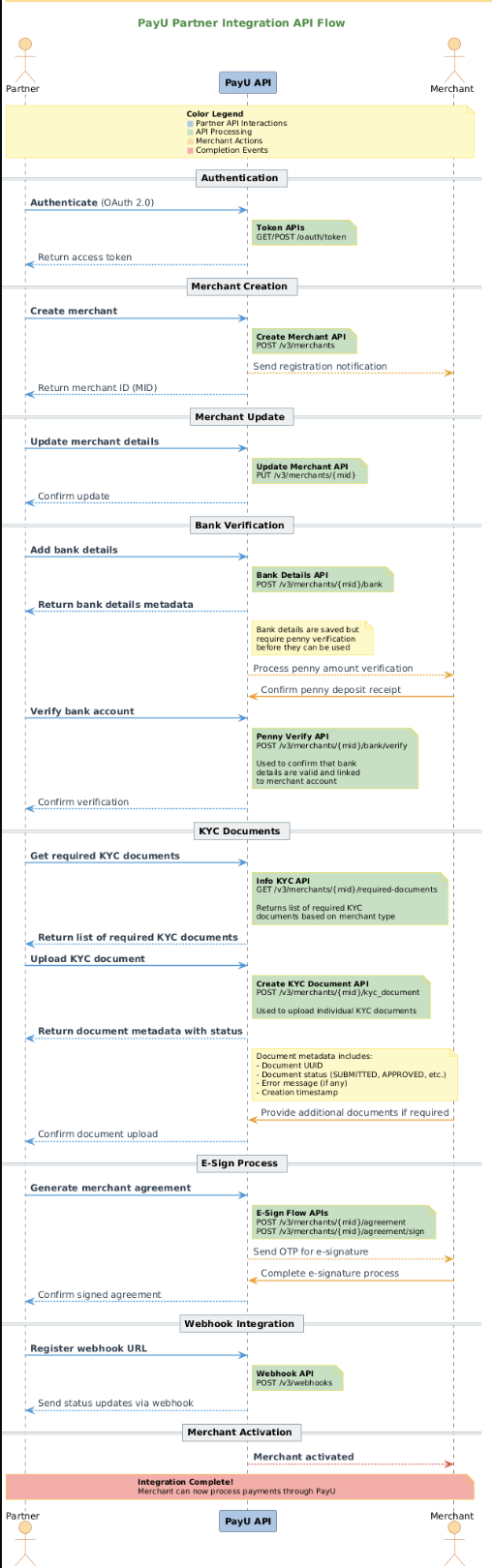
Flow Diagram
Here is a diagram for the high-level integration flow:
Security Best Practices
When integrating with PayU's APIs, follow these security best practices:
- Implement proper token management
- Use HTTPS for all communications
- Validate webhook signatures
- Securely store sensitive data
- Implement proper error handling
Testing Recommendations
Testing is essential before moving to production. PayU provides a sandbox environment for testing purposes. Test key aspects including:
- Authentication flows
- Merchant creation and updates
- Document uploads
- Bank verification
- Error handling
- Webhook processing
Updated 3 months ago
