
PayPal Integration
Integrate PayU with PayPal wallets to facilitate international payments. PayPal can be seamlessly integrated with your PayU Hosted or Merchant Hosted Checkout integration. Customers have the option to utilize PayPal Currency Conversion to convert international payments from INR (or other currencies) to their chosen currency. Payments made through PayPal are directly transferred to your PayPal wallet, with settlements processed in INR.
This section describes the following:
Customer journey
- Customer is redirected to PayU Payment page.
- Customer selects the Wallets option.
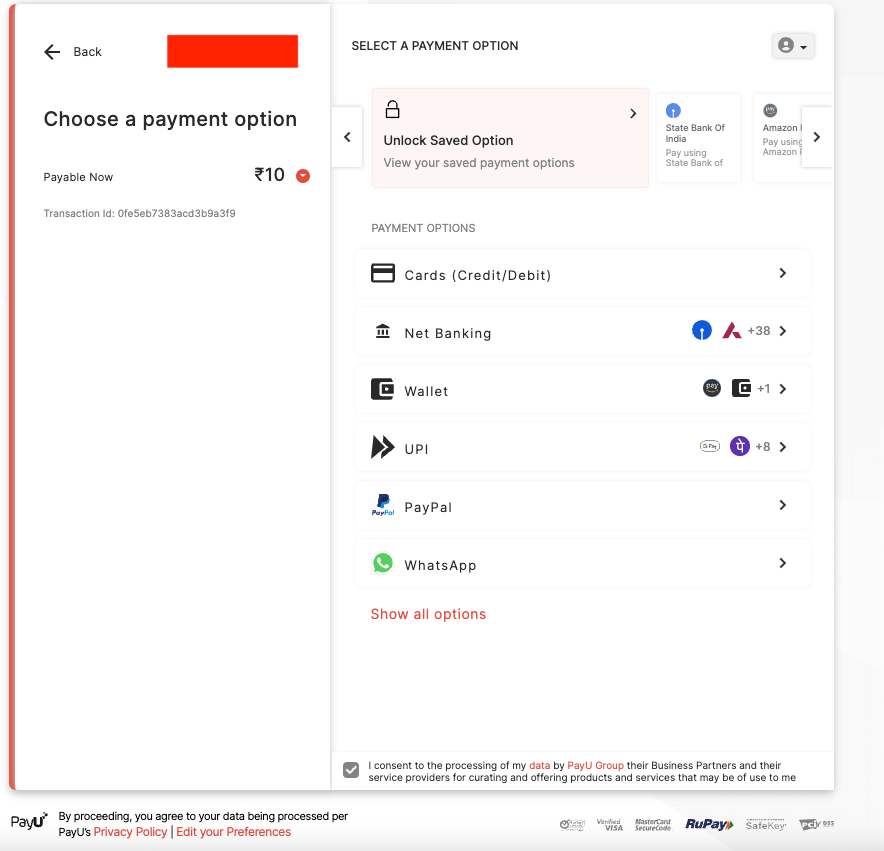
- Customer selects the Paypal option.
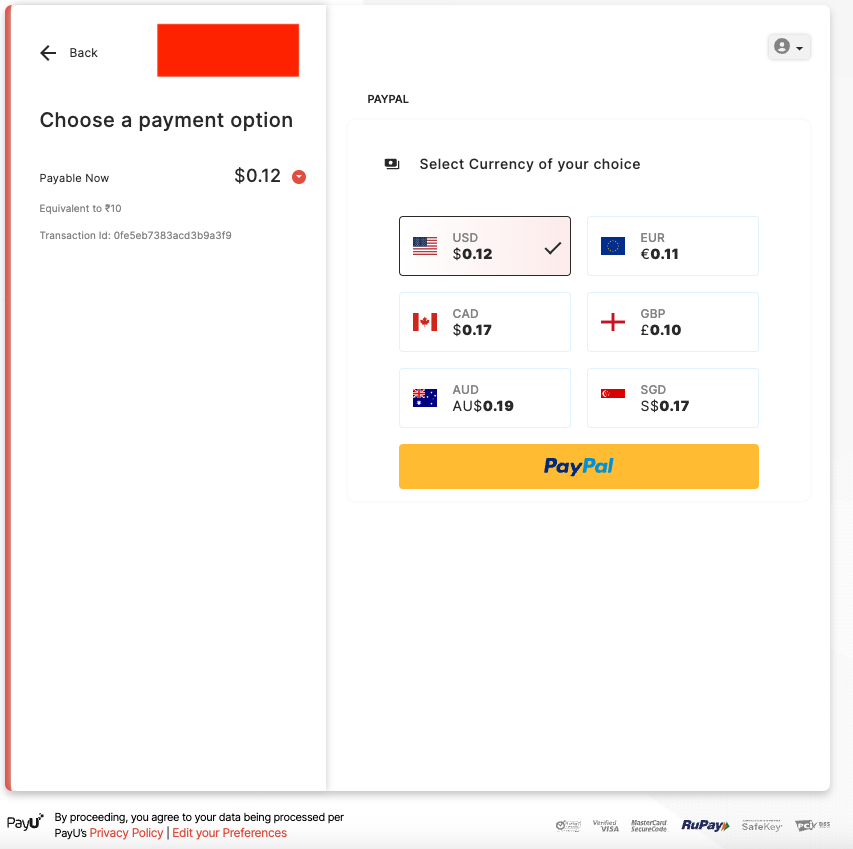
- Customer selects the preferred currency and clicks PayPal. The success or failure response is sent back to you by PayU after verification.
Benefits
- Improved Success Rates: Experience success rates up to 20% higher.
- Accelerated Settlement: Receive payments on a T+1 settlement schedule.
- Extensive User Base: Access over 30 Crore PayPal users worldwide.
- No Extra Charges: Transaction rates are determined by PayPal.
- Currency Conversion: Facilitate currency conversions from INR to your customers' preferred currencies.
Steps to Integrate
Step 1: Initiate the payment to PayU
You need to use bankcode as PAYPAL with the pg as PAYPAL.
Reference: For the Try It experience, refer to Collect Payments API under API Reference.
Environment
| Test Environment | https://test.payu.in/_payment |
| Production Environment | https://secure.payu.in/_payment |
Mandatory Parameters
| Parameter | Description | Example |
|---|---|---|
| key | String The unique merchant key provided by PayU for your merchant account. | 8488225 |
| txnid | varchar The Transaction ID (or OrderID). Order reference number generated at merchant's end. Must be unique for every new transaction. | fd3e847h2 |
| amount | float The payment amount of the particular transaction. Type-cast to float type. | 10 |
| productinfo | varchar A brief product description. | T-shirt |
| firstname | varchar The first name of the customer. | Ankit |
varchar The email of the customer. | [email protected] | |
| phone | integer The customer's phone number. | 9876543210 |
| pg | String It defines the payment category using Merchant Hosted Checkout integration. For Wallet payment, "PAYPAL" must be specified. | PAYPAL |
| bankcode | String The merchant must post PAYPAL as the value for this parameter. | PAYPAL |
| surl | The success URL — the page PayU will redirect to if the transaction is successful. | https://apiplayground-response.herokuapp.com/ |
| furl | The failure URL — the page PayU will redirect to if the transaction fails. | https://apiplayground-response.herokuapp.com/ |
| hash | String The hash calculated by the merchant using key and salt. SHA-512(key|txnid|amount|productinfo|firstname|email|udf1|udf2|udf3|udf4|udf5||||||Salt) | calculated_hash_value |
Optional Parameters
| Parameter | Description | Example |
|---|---|---|
| lastname | String The last name of the customer. | Kumar |
| address1 | String The first line of the billing address. | 123 Main St |
| address2 | String The second line of the billing address. | Apt 4B |
| city | String The city where your customer resides as part of the billing address. | Mumbai |
| state | String The state where your customer resides as part of the billing address. | Maharashtra |
| country | String The country where your customer resides. | India |
| zipcode | String Billing address zip code is mandatory for the cardless EMI option. | 400001 |
| udf1 | String This parameter has been made for you to keep any information corresponding to the transaction. | custom_data_1 |
| udf2 | String This parameter has been made for you to keep any information corresponding to the transaction. | custom_data_2 |
| udf3 | String This parameter has been made for you to keep any information corresponding to the transaction. | custom_data_3 |
| udf4 | String This parameter has been made for you to keep any information corresponding to the transaction. | custom_data_4 |
| udf5 | String This parameter has been made for you to keep any information corresponding to the transaction. | custom_data_5 |
Understanding Hashing and sample code
Hashing
You must hash the request parameters using the following hash logic:
sha512(key|txnid|amount|productinfo|firstname|email|udf1|udf2|udf3|udf4|udf5||||||SALT)For more information, refer to Generate Hash.
Hashing Sample Code
<?php
function generateHash($params, $salt) {
    // Extract parameters or use empty string if not provided
    $key = $params['key'];
    $txnid = $params['txnid'];
    $amount = $params['amount'];
    $productinfo = $params['productinfo'];
    $firstname = $params['firstname'];
    $email = $params['email'];
    $udf1 = isset($params['udf1']) ? $params['udf1'] : '';
    $udf2 = isset($params['udf2']) ? $params['udf2'] : '';
    $udf3 = isset($params['udf3']) ? $params['udf3'] : '';
    $udf4 = isset($params['udf4']) ? $params['udf4'] : '';
    $udf5 = isset($params['udf5']) ? $params['udf5'] : '';

    // Construct hash string with exact parameter sequence
    $hashString = $key . '|' . $txnid . '|' . $amount . '|' . $productinfo . '|' .
                  $firstname . '|' . $email . '|' . $udf1 . '|' . $udf2 . '|' .
                  $udf3 . '|' . $udf4 . '|' . $udf5 . '||||||' . $salt;

    // Generate hash and convert to lowercase
    return strtolower(hash('sha512', $hashString));
}

// Example usage
$params = [
    'key' => 'yourKey',
    'txnid' => 'yourTxnId',
    'amount' => 'yourAmount',
    'productinfo' => 'yourProductInfo',
    'firstname' => 'yourFirstName',
    'email' => 'yourEmail',
    'udf1' => 'optional_value1'
    // udf2, udf3, udf4, udf5 not provided - will be empty strings
];
$salt = 'yourSalt';

$hash = generateHash($params, $salt);
echo 'Generated Hash: ' . $hash;
?>
import java.nio.charset.StandardCharsets;
import java.security.MessageDigest;
import java.security.NoSuchAlgorithmException;
import java.util.HashMap;
import java.util.Map;

public class ImprovedHashGenerator {

    public static String generateHash(Map<String, String> params, String salt) {
        // Extract parameters or use empty string if not provided
        String key = params.get("key");
        String txnid = params.get("txnid");
        String amount = params.get("amount");
        String productinfo = params.get("productinfo");
        String firstname = params.get("firstname");
        String email = params.get("email");
        String udf1 = params.getOrDefault("udf1", "");
        String udf2 = params.getOrDefault("udf2", "");
        String udf3 = params.getOrDefault("udf3", "");
        String udf4 = params.getOrDefault("udf4", "");
        String udf5 = params.getOrDefault("udf5", "");

        // Construct hash string with exact parameter sequence
        String hashString = key + "|" + txnid + "|" + amount + "|" + productinfo + "|" +
                         firstname + "|" + email + "|" + udf1 + "|" + udf2 + "|" +
                         udf3 + "|" + udf4 + "|" + udf5 + "||||||" + salt;

        return sha512(hashString);
    }

    private static String sha512(String input) {
        try {
            MessageDigest md = MessageDigest.getInstance("SHA-512");
            byte[] hashBytes = md.digest(input.getBytes(StandardCharsets.UTF_8));
            StringBuilder sb = new StringBuilder();
            for (byte b : hashBytes) {
                sb.append(String.format("%02x", b));
            }
            return sb.toString().toLowerCase();
        } catch (NoSuchAlgorithmException e) {
            throw new RuntimeException(e);
        }
    }

    public static void main(String[] args) {
        // Example usage with parameters map
        Map<String, String> params = new HashMap<>();
        params.put("key", "yourKey");
        params.put("txnid", "yourTxnId");
        params.put("amount", "yourAmount");
        params.put("productinfo", "yourProductInfo");
        params.put("firstname", "yourFirstName");
        params.put("email", "yourEmail");
        params.put("udf1", "optional_value1");
        // udf2, udf3, udf4, udf5 not provided - will be empty strings

        String salt = "yourSalt";

        String hash = generateHash(params, salt);
        System.out.println("Generated Hash: " + hash);
    }
}
using System;
using System.Collections.Generic;
using System.Security.Cryptography;
using System.Text;

public class ImprovedHashGenerator
{
    public static string GenerateHash(Dictionary<string, string> parameters, string salt)
    {
        // Extract parameters or use empty string if not provided
        string key = parameters["key"];
        string txnid = parameters["txnid"];
        string amount = parameters["amount"];
        string productinfo = parameters["productinfo"];
        string firstname = parameters["firstname"];
        string email = parameters["email"];

        // Get UDF values if present, otherwise use empty string
        string udf1 = parameters.ContainsKey("udf1") ? parameters["udf1"] : "";
        string udf2 = parameters.ContainsKey("udf2") ? parameters["udf2"] : "";
        string udf3 = parameters.ContainsKey("udf3") ? parameters["udf3"] : "";
        string udf4 = parameters.ContainsKey("udf4") ? parameters["udf4"] : "";
        string udf5 = parameters.ContainsKey("udf5") ? parameters["udf5"] : "";

        // Construct hash string with exact parameter sequence
        string hashString = $"{key}|{txnid}|{amount}|{productinfo}|{firstname}|{email}|{udf1}|{udf2}|{udf3}|{udf4}|{udf5}||||||{salt}";

        return Sha512(hashString);
    }

    private static string Sha512(string input)
    {
        using (SHA512 sha512 = SHA512.Create())
        {
            byte[] bytes = sha512.ComputeHash(Encoding.UTF8.GetBytes(input));
            StringBuilder sb = new StringBuilder();
            foreach (byte b in bytes)
            {
                sb.Append(b.ToString("x2"));
            }
            return sb.ToString().ToLower();
        }
    }

    public static void Main(string[] args)
    {
        // Example usage with parameters dictionary
        Dictionary<string, string> parameters = new Dictionary<string, string>
        {
            ["key"] = "yourKey",
            ["txnid"] = "yourTxnId",
            ["amount"] = "yourAmount",
            ["productinfo"] = "yourProductInfo",
            ["firstname"] = "yourFirstName",
            ["email"] = "yourEmail",
            ["udf1"] = "optional_value1"
            // udf2, udf3, udf4, udf5 not provided - will be empty strings
        };

        string salt = "yourSalt";

        string hash = GenerateHash(parameters, salt);
        Console.WriteLine("Generated Hash: " + hash);
    }
}
import hashlib
def generate_hash(params, salt):
# Extract parameters or use empty string if not provided
key = params['key']
txnid = params['txnid']
amount = params['amount']
productinfo = params['productinfo']
firstname = params['firstname']
email = params['email']
udf1 = params.get('udf1', '')
udf2 = params.get('udf2', '')
udf3 = params.get('udf3', '')
udf4 = params.get('udf4', '')
udf5 = params.get('udf5', '')
# Construct hash string with exact parameter sequence
hash_string = f"{key}|{txnid}|{amount}|{productinfo}|{firstname}|{email}|{udf1}|{udf2}|{udf3}|{udf4}|{udf5}||||||{salt}"
# Generate SHA-512 hash
return hashlib.sha512(hash_string.encode('utf-8')).hexdigest()
# Example usage
params = {
'key': 'yourKey',
'txnid': 'yourTxnId',
'amount': 'yourAmount',
'productinfo': 'yourProductInfo',
'firstname': 'yourFirstName',
'email': 'yourEmail',
'udf1': 'optional_value1'
# udf2, udf3, udf4, udf5 not provided - will default to empty strings
}
salt = 'yourSalt'
hash_value = generate_hash(params, salt)
print("Generated Hash:", hash_value)
const crypto = require('crypto');

function generateHash(params, salt) {
    // Extract parameters or use empty string if not provided
    const key = params.key;
    const txnid = params.txnid;
    const amount = params.amount;
    const productinfo = params.productinfo;
    const firstname = params.firstname;
    const email = params.email;
    const udf1 = params.udf1 || '';
    const udf2 = params.udf2 || '';
    const udf3 = params.udf3 || '';
    const udf4 = params.udf4 || '';
    const udf5 = params.udf5 || '';

    // Construct hash string with exact parameter sequence
    const hashString = `${key}|${txnid}|${amount}|${productinfo}|${firstname}|${email}|${udf1}|${udf2}|${udf3}|${udf4}|${udf5}||||||${salt}`;

    // Generate SHA-512 hash
    return crypto.createHash('sha512').update(hashString).digest('hex');
}

// Example usage
const params = {
    key: 'yourKey',
    txnid: 'yourTxnId',
    amount: 'yourAmount',
    productinfo: 'yourProductInfo',
    firstname: 'yourFirstName',
    email: 'yourEmail',
    udf1: 'optional_value1'
    // udf2, udf3, udf4, udf5 not provided - will default to empty strings
};
const salt = 'yourSalt';

const hash = generateHash(params, salt);
console.log("Generated Hash:", hash);
curl -X POST "https://test.payu.in/_payment" \
  -H "accept: application/json" \
  -H "Content-Type: application/x-www-form-urlencoded" \
  -d "key=J****g&txnid=aI1UM19ONxLgPz&amount=10.00&firstname=Ashish&[email protected]&phone=9876543210&productinfo=iPhone&pg=PAYPAL&bankcode=PAYPAL&surl=https://apiplayground-response.herokuapp.com/&furl=https://apiplayground-response.herokuapp.com/&hash=6840ba0d1a14554f7ee5d20966dfbac6b221718e72dd823f05b6da01420286315b4956c28325898b66520b111604020ea2c547608606674766eb7e4164dc0baa"
import requests
url = "https://test.payu.in/_payment"
headers = {
"accept": "application/json",
"Content-Type": "application/x-www-form-urlencoded"
}
data = {
"key": "J****g",
"txnid": "aI1UM19ONxLgPz",
"amount": "10.00",
"firstname": "Ashish",
"email": "[email protected]",
"phone": "9876543210",
"productinfo": "iPhone",
"pg": "PAYPAL",
"bankcode": "PAYPAL",
"surl": "https://apiplayground-response.herokuapp.com/",
"furl": "https://apiplayground-response.herokuapp.com/",
"hash": "6840ba0d1a14554f7ee5d20966dfbac6b221718e72dd823f05b6da01420286315b4956c28325898b66520b111604020ea2c547608606674766eb7e4164dc0baa"
}
response = requests.post(url, headers=headers, data=data)
print(response.status_code)
print(response.text)using System;
using System.Collections.Generic;
using System.Net.Http;
using System.Threading.Tasks;
class Program
{
static async Task Main(string[] args)
{
using (var client = new HttpClient())
{
client.DefaultRequestHeaders.Add("accept", "application/json");
var formData = new List<KeyValuePair<string, string>>
{
new KeyValuePair<string, string>("key", "J****g"),
new KeyValuePair<string, string>("txnid", "aI1UM19ONxLgPz"),
new KeyValuePair<string, string>("amount", "10.00"),
new KeyValuePair<string, string>("firstname", "Ashish"),
new KeyValuePair<string, string>("email", "[email protected]"),
new KeyValuePair<string, string>("phone", "9876543210"),
new KeyValuePair<string, string>("productinfo", "iPhone"),
new KeyValuePair<string, string>("pg", "PAYPAL"),
new KeyValuePair<string, string>("bankcode", "PAYPAL"),
new KeyValuePair<string, string>("surl", "https://apiplayground-response.herokuapp.com/"),
new KeyValuePair<string, string>("furl", "https://apiplayground-response.herokuapp.com/"),
new KeyValuePair<string, string>("hash", "6840ba0d1a14554f7ee5d20966dfbac6b221718e72dd823f05b6da01420286315b4956c28325898b66520b111604020ea2c547608606674766eb7e4164dc0baa")
};
var response = await client.PostAsync("https://test.payu.in/_payment", new FormUrlEncodedContent(formData));
Console.WriteLine($"Status: {response.StatusCode}");
Console.WriteLine($"Response: {await response.Content.ReadAsStringAsync()}");
}
}
}async function makePayPalPayment() {
const url = "https://test.payu.in/_payment";
const formData = new URLSearchParams({
"key": "J****g", "txnid": "aI1UM19ONxLgPz", "amount": "10.00",
"firstname": "Ashish", "email": "[email protected]", "phone": "9876543210",
"productinfo": "iPhone", "pg": "PAYPAL", "bankcode": "PAYPAL",
"surl": "https://apiplayground-response.herokuapp.com/",
"furl": "https://apiplayground-response.herokuapp.com/",
"hash": "6840ba0d1a14554f7ee5d20966dfbac6b221718e72dd823f05b6da01420286315b4956c28325898b66520b111604020ea2c547608606674766eb7e4164dc0baa"
});
const response = await fetch(url, { method: "POST", headers: { "accept": "application/json", "Content-Type": "application/x-www-form-urlencoded" }, body: formData });
console.log("Status:", response.status);
console.log("Response:", await response.text());
}
makePayPalPayment();import java.io.IOException;
import java.net.URI;
import java.net.http.HttpClient;
import java.net.http.HttpRequest;
import java.net.http.HttpResponse;
import java.util.HashMap;
import java.util.Map;
import java.util.stream.Collectors;
public class PayPalPayment {
public static void main(String[] args) throws IOException, InterruptedException {
String url = "https://test.payu.in/_payment";
Map<String, String> formData = new HashMap<>();
formData.put("key","J****g"); formData.put("txnid","aI1UM19ONxLgPz"); formData.put("amount","10.00");
formData.put("firstname","Ashish"); formData.put("email","[email protected]"); formData.put("phone","9876543210");
formData.put("productinfo","iPhone"); formData.put("pg","PAYPAL"); formData.put("bankcode","PAYPAL");
formData.put("surl","https://apiplayground-response.herokuapp.com/");
formData.put("furl","https://apiplayground-response.herokuapp.com/");
formData.put("hash","6840ba0d1a14554f7ee5d20966dfbac6b221718e72dd823f05b6da01420286315b4956c28325898b66520b111604020ea2c547608606674766eb7e4164dc0baa");
String formBody = formData.entrySet().stream().map(e -> e.getKey()+"="+e.getValue()).collect(Collectors.joining("&"));
HttpClient client = HttpClient.newHttpClient();
HttpRequest request = HttpRequest.newBuilder().uri(URI.create(url))
.header("accept","application/json").header("Content-Type","application/x-www-form-urlencoded")
.POST(HttpRequest.BodyPublishers.ofString(formBody)).build();
HttpResponse<String> response = client.send(request, HttpResponse.BodyHandlers.ofString());
System.out.println("Status Code: " + response.statusCode());
System.out.println("Response Body: " + response.body());
}
}<?php
$url = "https://test.payu.in/_payment";
$data = array(
'key' => 'J****g', 'txnid' => 'aI1UM19ONxLgPz', 'amount' => '10.00',
'firstname' => 'Ashish', 'email' => '[email protected]', 'phone' => '9876543210',
'productinfo' => 'iPhone', 'pg' => 'PAYPAL', 'bankcode' => 'PAYPAL',
'surl' => 'https://apiplayground-response.herokuapp.com/',
'furl' => 'https://apiplayground-response.herokuapp.com/',
'hash' => '6840ba0d1a14554f7ee5d20966dfbac6b221718e72dd823f05b6da01420286315b4956c28325898b66520b111604020ea2c547608606674766eb7e4164dc0baa'
);
$ch = curl_init();
curl_setopt($ch, CURLOPT_URL, $url);
curl_setopt($ch, CURLOPT_POST, true);
curl_setopt($ch, CURLOPT_POSTFIELDS, http_build_query($data));
curl_setopt($ch, CURLOPT_RETURNTRANSFER, true);
curl_setopt($ch, CURLOPT_HTTPHEADER, array('accept: application/json', 'Content-Type: application/x-www-form-urlencoded'));
$response = curl_exec($ch);
$httpCode = curl_getinfo($ch, CURLINFO_HTTP_CODE);
curl_close($ch);
echo "HTTP Code: " . $httpCode . "\n";
echo "Response: " . $response;
?>
Note:Ensure your PayPal account maintains sufficient funds before initiating a refund. Refunds can be initiated either through the PayU Dashboard or the Refund Transaction API. For more information, refer to:
Step 2: Check the response from PayU
Sample response
Array
(
    [mihpayid] => 403993715527518775
    [mode] => PAYPAL
    [status] => success
    [PG_TYPE] => PAYPAL-PG
    [bank_ref_num] => 540898ed-72e7-40a8-a96e-f17de621cbb4
    [bankcode] => PAYPAL
    [field4] => 0.12
    [field5] => USD
    [error] => E000
    [error_Message] => No Error
)
Step 3: Verify the payment
Upon receiving the response, PayU recommends you performing a reconciliation step to validate all transaction details.
You can verify your payments using either of the following methods:
Configure the webhooks to monitor the status of payments.
Webhooks enable a server to communicate with another server by sending an HTTP callback or message.
These callbacks are triggered by specific events or instances and operate at the server-to-server (S2S) level.
Know how to manage Webhooks for Payments.
Environment
| Test Environment | https://test.payu.in/merchant/postservice.php?form=2 |
| Production Environment | https://info.payu.in/merchant/postservice.php?form=2 |
Note: The hash logic for Verify Payment API is:
sha512(key|command|var1|salt) sha512
Sample request
curl --request POST
--url 'https://test.payu.in/merchant/postservice?form=2'
--header 'Content-Type: application/x-www-form-urlencoded'
--data key=JPM7Fg
--data command=verify_payment
--data var1=IhfgcZnXR4o4nB
--data hash=a0ae79fdd66c875af6e9b21c4a67f1822deb00f2df5e9f0b1948f3222f536a9bf741b24efbb1874ca0f84f76b036e6c0d641581d0100f7abe4aeed2f3264f5c9
Sample response
If credit card payment is made, the response is similar to the following:
{
  "status":0,
  "msg":"0 out of 1 Transactions Fetched Successfully",
  "transaction_details":
{
"IhfgcZnXR4o4nB":
{
"mihpayid":"Not Found",
"status":"Not Found"
}
}
}
If txnID is not found, the response is similar to the following:
{
    "status":0,
    "msg":"0 out of 1 Transactions Fetched Successfully",
      "transaction_details":
      {
                      "IhfgcZnXR4o4nB":
        {
                              "mihpayid":"Not Found",
            "status":"Not Found"
          }
                      }
}
Response parameters
| Parameter | Description | Example |
|---|---|---|
| status | This parameter returns the status of web service call. The status can be any of the following:
| 0 |
| msg | This parameter returns the reason string. | For example, any of the following messages are displayed:
|
| transaction_details | This parameter contains the response in a JSON format. For more information refer to JSON fields description for transaction_details parameter . | |
| request_id | PayU Request ID for a request in a Transaction. For example, a transaction can have a refund request. | 7800456 |
| bank_ref_num | This parameter returns the bank reference number. If the bank provides after a successful action. | 204519474956 |
To learn more about the possible error codes and their description, refer to Error Codes.
Updated about 1 month ago
